Choosing cabinets is one of the biggest decisions in a kitchen remodel, but it is also one of the easiest decisions to make confusing. Homeowners often hear terms like inset cabinets, frameless cabinets, shaker cabinets, overlay doors, slab fronts, custom cabinetry and semi-custom cabinetry in the same conversation. The words sound similar, but they do not always describe the same thing.
The simplest way to understand the difference is this: inset and frameless usually describe how a cabinet is built and how the door sits on the cabinet box. Shaker describes the door style. That means a kitchen can have shaker doors on a framed cabinet, shaker doors on a frameless cabinet, or even an inset shaker cabinet. Once that distinction is clear, the decision becomes much easier.
For Atlanta, Roswell, Alpharetta, Milton and nearby homeowners, the right cabinet choice depends on more than a photo saved from Pinterest. It depends on the architecture of the home, the amount of storage needed, the preferred level of detail, the countertop selection, the appliance plan, the budget and the way the kitchen will be used every day. This guide compares inset, frameless and shaker cabinets in practical terms so you can choose a cabinet direction with more confidence before your remodel begins.
Quick Answer: What Is the Difference Between Inset, Frameless and Shaker Cabinets?
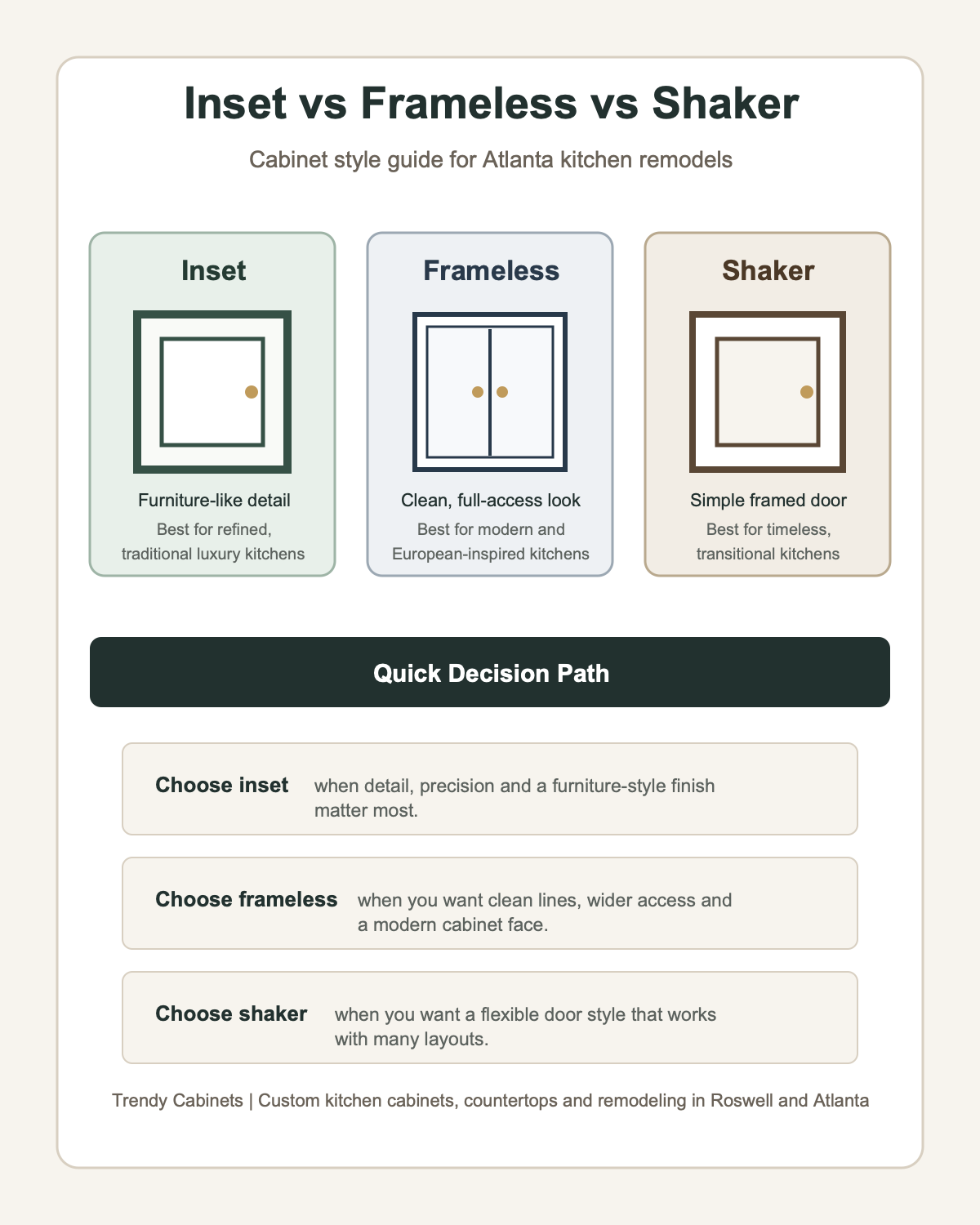
Inset cabinets have doors and drawer fronts that sit inside the cabinet frame. This creates a flush, furniture-like look with clean reveal lines around each door and drawer. Inset cabinetry is often associated with high-end traditional, transitional and custom kitchens because it requires careful construction and precise installation.
Frameless cabinets, sometimes called European-style cabinets, do not have a traditional face frame on the front of the cabinet box. The doors usually cover most of the cabinet face, creating a cleaner, more modern look with wider interior access. Frameless cabinets are popular in contemporary kitchens, modern remodels and storage-focused layouts.
Shaker cabinets are defined by the door design: a recessed center panel with a simple frame around it. Shaker doors can be used in many different cabinet systems. They can feel classic, transitional, modern farmhouse, coastal, warm contemporary or minimalist depending on the finish, hardware, countertop and backsplash.
If you want the most direct answer, inset cabinets are best when detail and craftsmanship matter most, frameless cabinets are best when clean lines and storage access matter most, and shaker cabinets are best when you want a flexible, timeless door style that can work in many Atlanta homes.
Inset vs Frameless vs Shaker Cabinets at a Glance
| Cabinet choice | What it describes | Best fit | Design feel | Planning note |
|---|---|---|---|---|
| Inset cabinets | Door and drawer fronts sit inside a face frame | Luxury, traditional and refined transitional kitchens | Precise, furniture-like and detailed | Requires accurate measuring, installation and alignment |
| Frameless cabinets | Cabinet box has no front face frame | Modern kitchens, storage-heavy layouts and clean designs | Sleek, efficient and European-inspired | Works well with slab doors, modern shaker and full-overlay looks |
| Shaker cabinets | Door style with recessed center panel | Transitional, classic, farmhouse, coastal and updated traditional kitchens | Simple, familiar and flexible | Can be paired with framed, inset, overlay or frameless construction |
Why This Cabinet Decision Matters So Much
Cabinets shape the kitchen more than almost any other visible material. They affect storage, workflow, wall elevations, island size, appliance integration, hardware placement, countertop support, backsplash proportions and the overall mood of the home. A cabinet style that looks beautiful in a showroom may feel wrong if it does not match the room’s architecture or the homeowner’s daily routine.
In Atlanta homes, this decision often becomes especially important because many remodels involve open floor plans. The kitchen is not hidden behind a wall. It can be seen from the living room, dining area or entry. That means cabinet style needs to feel connected to the rest of the home. A very modern frameless kitchen may look stunning in a contemporary home, but it can feel abrupt in a traditional brick house if the surrounding finishes are not updated with it. An inset kitchen can feel rich and tailored, but it may not be the right choice for a homeowner who wants a very simple, flat, modern surface.
Cabinets also influence how a remodel budget is used. Inset construction, specialty finishes, custom panels, tall storage walls, drawer-heavy layouts and decorative trim can all change the investment. Frameless cabinetry may create a cleaner look and efficient storage access, but the final cost still depends on the cabinet line, material, finish and hardware. Shaker cabinets can be budget-friendly or high-end depending on construction, finish, customization and installation.
That is why this choice should be made with the full design plan in mind. Cabinets should not be selected separately from countertops, backsplash, hardware, lighting, flooring and appliance decisions. If you are still comparing the broader scope of a kitchen remodel, Trendy Cabinets’ kitchen remodeling services page is a useful place to understand how cabinetry fits into the larger project.
What Are Inset Cabinets?
Inset cabinets are built so the doors and drawer fronts sit within the cabinet face frame instead of sitting on top of it. When installed properly, the cabinet front looks flush and precise. The small reveal lines around each door become part of the design. This gives inset cabinetry a tailored, furniture-like appearance that many homeowners associate with custom millwork.
Inset cabinets are often chosen for kitchens where detail matters. They work beautifully with traditional homes, classic Atlanta architecture, transitional remodels and luxury kitchens that need a refined finish. They also pair well with custom hoods, paneled appliances, decorative feet, glass-front upper cabinets, furniture-style islands and carefully selected hardware.
The main advantage of inset cabinetry is visual quality. It feels intentional and crafted. The door does not simply cover the front of the cabinet; it becomes part of a precise frame. This can make a kitchen feel more architectural and more permanent. If the goal is a kitchen that looks built into the home rather than installed as a separate product, inset cabinetry can be a strong direction.

There are practical considerations. Because the doors sit inside the frame, inset cabinets require careful alignment. Small changes in humidity, settling or installation can be more noticeable than with full-overlay doors. They may also provide slightly less interior opening width compared with some frameless systems because the face frame and inset door relationship takes up space. That does not make inset cabinets impractical, but it does mean planning and installation quality matter.
Inset cabinets usually belong in a thoughtful design plan. They are not only a door choice; they affect hardware, reveals, hinges, trim, panel details and installation expectations. For a deeper comparison between inset and other cabinet construction styles, see Trendy Cabinets’ guide to frameless vs. inset cabinets in Atlanta luxury kitchens.
When Inset Cabinets Make Sense
Inset cabinets make sense when the homeowner wants a kitchen that feels detailed, refined and custom. They are a good fit for homes where the architecture already has traditional or transitional character. Crown molding, paneled doors, real wood flooring, built-ins, arched openings and classic trim details can all support the inset look.
They also work well when the island is meant to feel like a piece of furniture. A painted perimeter with a stained wood inset island can look rich without feeling overly busy. Inset cabinetry can also support a more formal kitchen when paired with marble-look quartz, natural stone, polished nickel hardware, brass accents or a custom range hood.
Inset may be less ideal when the homeowner wants the cleanest possible modern face, the widest possible cabinet access or a very tight budget. It is also not the best choice if the installation team is not experienced with alignment and fine cabinet details. Inset cabinets reward precision. If that precision is missing, the design can lose the very quality that made inset appealing in the first place.
What Are Frameless Cabinets?
Frameless cabinets are built without a traditional face frame on the front of the cabinet box. The door attaches directly to the side of the cabinet box, and the cabinet front is mostly covered by doors and drawer fronts. This creates a cleaner, more continuous appearance with narrow gaps between cabinet fronts.
Frameless cabinetry is often connected with European design because it creates a sleek, efficient cabinet system. It can work with slab doors, textured finishes, matte colors, high-gloss surfaces, modern wood grains and minimalist hardware. It can also work with simple shaker doors when the goal is a cleaner transitional look.
The biggest practical benefit is access. Because there is no face frame at the front of the cabinet box, the opening can feel wider and easier to use. This can be helpful in drawer-heavy kitchens, pantry storage, small kitchens and modern layouts where every inch matters. Frameless construction can also help create a smooth wall of cabinetry, especially when appliances, tall pantry units and integrated panels are part of the design.
Frameless cabinets are not only for ultra-modern kitchens. In many Atlanta remodels, frameless cabinetry is used to create an updated but warm kitchen. Natural wood slab doors, soft white flat-panel fronts, slim shaker doors, matte black hardware and quartz countertops can make frameless cabinetry feel inviting rather than cold.

Like any cabinet system, quality matters. Frameless cabinets rely on strong box construction, accurate manufacturing and good hardware. Hinges, slides and installation details must be appropriate for the design. If the kitchen includes long door runs, large panels or heavy drawers, the cabinet line and installation plan should support those choices.
When Frameless Cabinets Make Sense
Frameless cabinets make sense when the homeowner wants a cleaner visual line, wider interior access and a more current cabinet face. They are a natural fit for modern kitchens, contemporary remodels, condo kitchens, open-plan homes and storage-focused layouts. They can also be useful in compact spaces where the extra access makes the cabinets easier to use.
Frameless cabinetry works especially well with slab doors and simple hardware. It can also pair beautifully with quartz countertops, full-height backsplash, waterfall islands, under-cabinet lighting and integrated appliances. If the kitchen design uses long horizontal lines, large drawers and simple surfaces, frameless construction may support that direction better than a detailed framed cabinet.
Frameless may be less ideal when the homeowner wants a heavily traditional kitchen with face-frame detail, exposed hinges or furniture-style reveals. It can still be used in transitional spaces, but the finish, door style and hardware need to be chosen carefully so the kitchen does not feel disconnected from the rest of the home.
What Are Shaker Cabinets?
Shaker cabinets are defined by the door style. A shaker door usually has a recessed center panel surrounded by a simple frame made of rails and stiles. The design is clean, balanced and familiar. It is one of the most popular cabinet styles because it can move between traditional and modern design depending on the details around it.
White shaker cabinets can feel classic and bright. Natural wood shaker cabinets can feel warm and organic. Navy or green shaker cabinets can feel bold but still grounded. Slim shaker doors can lean modern. Wider rails can feel more traditional. Add brass hardware, and the kitchen may feel warm and transitional. Add black hardware, and it may feel sharper and more graphic. Pair shaker cabinets with a marble-look countertop, and the kitchen can feel elegant. Pair them with butcher block or zellige-look tile, and the room can feel more casual.
This flexibility is the reason shaker cabinets are so common in Atlanta kitchen remodels. They work in newer suburban homes, older traditional homes, townhomes, rental properties and custom remodels. They can also be used at many budget levels, from straightforward semi-custom cabinetry to high-end custom inset shaker cabinetry.
The important thing to remember is that shaker is not the same kind of category as inset or frameless. Shaker describes the door design. Inset and frameless describe cabinet construction and door placement. A homeowner can choose shaker doors and still need to decide whether the cabinet system should be framed, inset, full overlay or frameless.
When Shaker Cabinets Make Sense
Shaker cabinets make sense when the homeowner wants a timeless style that does not feel too plain or too ornate. They are a strong fit for transitional kitchens because they can bridge old and new. A shaker kitchen can respect a traditional home while still feeling updated. That is valuable in many Atlanta-area remodels where homeowners want a kitchen that looks fresh without clashing with the rest of the house.
Shaker cabinets are also a good choice when resale value is part of the decision. They are familiar to buyers, easy to style and less polarizing than very ornate or very minimal cabinet fronts. That does not mean every kitchen should be white shaker, but it does explain why shaker remains a dependable option.
Shaker may be less ideal when the homeowner wants an ultra-minimal modern look with no visible panel detail. In that case, slab doors or a very slim-profile door may be better. Shaker can also become too predictable if the rest of the design is not carefully layered. Countertops, backsplash, hardware, lighting and color choices help keep shaker cabinets from feeling generic.
Inset, Frameless and Shaker: Which One Looks Most High-End?
The most high-end option depends on the design goal. Inset cabinets often read as high-end because they require precise construction and create a custom furniture-like appearance. In a traditional or transitional kitchen, inset cabinetry can look very refined. It shows craft in the reveal lines, panel details and fit of the doors.
Frameless cabinets can also look high-end when the kitchen is designed with clean proportions, premium materials and careful installation. A wall of frameless walnut cabinets, a large quartz island, integrated appliances and full-height backsplash can feel just as luxurious as an inset kitchen, but in a different visual language.
Shaker cabinets can look high-end or simple depending on how they are built and finished. A basic shaker door in a standard white finish may feel practical and familiar. An inset shaker cabinet with a custom painted finish, well-chosen hardware, paneled appliances and detailed trim can feel premium. A slim shaker door on a frameless cabinet can feel fresh and upscale in a more modern way.
So the better question is not which cabinet type is automatically most expensive or most luxurious. The better question is which cabinet direction supports the home, the budget and the desired feeling of the kitchen.
Style Comparison for Atlanta Homes
| Home or kitchen style | Best cabinet direction | Why it works | Finish ideas |
|---|---|---|---|
| Traditional Atlanta home | Inset or classic shaker | Supports trim details, furniture-style islands and a more tailored kitchen | Soft white, warm gray, walnut, polished nickel or brass |
| Modern open-plan home | Frameless or slim shaker | Creates clean lines and keeps the kitchen visually calm from nearby rooms | Matte white, natural oak, walnut, charcoal or flat-panel colors |
| Transitional suburban kitchen | Shaker, inset shaker or simple frameless shaker | Balances updated design with familiar cabinet detail | White perimeter, wood island, navy island or warm neutral paint |
| Compact kitchen | Frameless or simple shaker | Improves access and avoids overly heavy cabinet details | Light finishes, simple pulls and calmer backsplash choices |
| Luxury remodel | Inset, premium frameless or custom shaker | Allows the cabinet plan to be tailored around appliances, panels and finish details | Inset painted cabinetry, walnut slab fronts, marble-look quartz or statement hood |
Storage and Function: Which Cabinet Type Works Best?
Storage should be part of the cabinet style decision from the beginning. A beautiful kitchen can still be frustrating if the drawers are too shallow, the pantry is poorly organized, the island lacks usable storage or the cooking zone does not have the right accessories nearby.
Frameless cabinets often have an advantage in access because the cabinet opening is not interrupted by a face frame. This can make it easier to reach inside cabinets and use wide drawers. For homeowners who want deep drawer bases, pull-out trays, tray dividers, spice pull-outs, waste storage and pantry organization, frameless cabinets can be a practical option.
Inset cabinets can still provide excellent storage, but the design has to be planned carefully. Because the doors sit inside the frame, the opening and hardware relationships need attention. This is especially important for drawer stacks, internal pull-outs and specialty accessories. A good cabinet plan can still make inset cabinetry highly functional; it simply requires precision.
Shaker cabinets do not automatically change storage because they describe the door style. A shaker kitchen can be storage-rich or storage-poor depending on the layout. The storage decisions come from cabinet sizes, drawer planning, pantry design, accessories and appliance placement. If storage is one of the top priorities, read Trendy Cabinets’ guide to small kitchen storage ideas for Atlanta custom cabinets before finalizing the cabinet plan.
Cost Considerations
Cabinet cost depends on construction, material, finish, customization, hardware, interior accessories, installation scope and the size of the kitchen. It is not possible to judge the full budget from the style name alone. Still, some patterns are common.
Inset cabinets are often more expensive because they require precise construction, careful door fit and detailed installation. They may also be selected alongside other premium features such as custom hoods, appliance panels, decorative trim and specialty finishes. That combination can raise the total project cost.
Frameless cabinets can range from moderate to high-end depending on the cabinet line and finish. A simple frameless system may be efficient, while a premium frameless kitchen with textured wood, large panels, integrated appliances and high-end hardware can become a significant investment.
Shaker cabinets can exist at many price points. A basic shaker door may be accessible, while inset shaker cabinets or custom painted shaker cabinetry can be premium. Hardware, finish quality and the number of drawers can change the price quickly.
If budget planning is one of your first questions, see Trendy Cabinets’ guide to custom cabinet costs in Atlanta. It breaks down the factors that affect pricing, including cabinet lines, door styles, finishes, accessories and installation scope.
Countertops and Backsplash Pairings
Cabinet style should be selected with countertops and backsplash in mind. These surfaces meet visually every day. If one element is highly detailed, the others may need to be calmer. If the cabinet style is very simple, the countertop or backsplash can add movement and texture.
Inset cabinets often pair well with natural stone looks, marble-look quartz, detailed hardware and more traditional backsplash layouts. A soft handmade-look tile, marble mosaic used carefully, full-height slab behind a range or classic subway tile can all support the refined look. The key is balance. Too many decorative elements can make an inset kitchen feel heavy.
Frameless cabinets often pair well with cleaner surfaces. Quartz countertops, large-format porcelain, full-height slab backsplash, minimal grout lines and integrated lighting can support the modern feel. A waterfall island can look especially strong with frameless cabinetry because both choices emphasize clean planes and simple lines.
Shaker cabinets can work with many countertop and backsplash combinations. White shaker cabinets with quartz and subway tile remain popular because the look is bright and familiar. Wood shaker cabinets with warm quartz and textured tile can feel more current. Navy shaker cabinets with a light countertop and simple backsplash can add contrast without becoming overwhelming.
For surface planning, compare Trendy Cabinets’ guides to quartz vs. granite countertops and kitchen backsplash ideas for Atlanta remodels. These decisions should support the cabinet direction, not compete with it.
Hardware: Small Detail, Big Difference
Hardware can completely change how inset, frameless and shaker cabinets feel. Inset cabinets often look beautiful with knobs, cup pulls, latches, polished nickel, antique brass or refined pulls. The hardware becomes part of the furniture-like character. Placement matters because the doors and drawers are framed with visible reveals.
Frameless cabinets often work well with long pulls, tab pulls, edge pulls or minimal hardware. Some homeowners choose touch-latch systems or very subtle pulls to keep the front clean. If large drawers are part of the design, pull length and comfort should be tested before final selection.
Shaker cabinets can go in many directions. Black pulls create contrast. Brass warms the design. Polished nickel feels classic. Wood knobs or simple round knobs can soften the look. The same shaker door can feel farmhouse, transitional, modern or classic depending on hardware.
One common mistake is choosing hardware too late. Hardware affects drilling, door proportions, appliance pulls, drawer function and the final visual rhythm of the kitchen. It should be reviewed with cabinet drawings before installation details are locked in.
Maintenance and Daily Use
Every cabinet style needs normal care, but some details affect daily maintenance. Inset cabinets have more visible reveal lines and require good alignment. If a door shifts over time, it may be more noticeable. This does not mean inset cabinets are fragile; it means they benefit from quality hinges, good installation and occasional adjustment if needed.
Frameless cabinets are often easy to wipe down because the fronts can be simple and continuous. Slab doors may show fingerprints depending on finish, sheen and color. Dark matte finishes can be dramatic, but they should be selected with maintenance expectations in mind.
Shaker cabinets have inside edges around the recessed center panel. Those edges can collect dust more than a slab door, especially in high-use kitchens. However, shaker doors are still practical for most households. A high-quality painted or stained finish and normal cleaning habits are usually enough.
Finish selection often matters more than the cabinet label. A durable finish, good hardware and a layout that supports real use will do more for daily satisfaction than choosing a style based only on appearance.
Common Mistakes to Avoid
The first mistake is comparing inset, frameless and shaker as if they are three identical categories. They are related, but they answer different questions. Inset asks how the door sits in the frame. Frameless asks how the cabinet box is built. Shaker asks what the door looks like. Understanding that distinction prevents confusion during design meetings.
The second mistake is choosing from a single inspiration photo. A photo may show a beautiful kitchen, but it may not reveal ceiling height, cabinet construction, appliance details, lighting, storage accessories or the actual budget. Use inspiration photos as a direction, not as the full plan.
The third mistake is ignoring the rest of the home. A kitchen can be updated without feeling disconnected. If the home has traditional trim and warm wood floors, a very stark frameless kitchen may need softer finishes to fit. If the home is modern and open, heavy traditional cabinetry may feel out of place.
The fourth mistake is focusing only on door style while ignoring layout. A shaker kitchen with poor drawer planning is still frustrating. An inset kitchen without enough pantry storage may look beautiful but underperform. A frameless kitchen with the wrong finish may feel flat. Cabinet style and cabinet function have to be planned together.
Decision Checklist
| Question | If your answer is yes | Cabinet direction to consider |
|---|---|---|
| Do you want a detailed, furniture-like kitchen? | You care about precision, reveals and a crafted look | Inset cabinets or inset shaker cabinets |
| Do you want clean lines and easier access? | You prefer a modern surface and storage efficiency | Frameless cabinets |
| Do you want a timeless door that fits many styles? | You want flexibility and broad resale appeal | Shaker cabinets |
| Is your home traditional or transitional? | The kitchen should respect existing trim and architecture | Inset, classic shaker or painted custom cabinetry |
| Is your kitchen compact? | Storage access and visual simplicity matter | Frameless or simple shaker |
| Are you planning a luxury remodel? | You want cabinet details coordinated with appliances and finishes | Custom inset, premium frameless or custom shaker |
How to Choose the Right Cabinet Direction
Start with the feeling you want from the room. If the kitchen should feel tailored, classic and highly detailed, inset cabinetry may be the right direction. If the kitchen should feel clean, open and modern, frameless cabinetry may be stronger. If the kitchen should feel timeless and flexible, shaker cabinets may give you the best balance.
Then look at the home. A kitchen remodel should improve the house, not fight it. Consider ceiling height, existing trim, flooring, windows, natural light, room size and the view from nearby spaces. A cabinet style that fits the home will usually age better than a style selected only because it is trending.
Next, think about storage. List what is currently frustrating: crowded lower cabinets, no pantry, poor drawer organization, awkward corner cabinets, not enough tray storage, appliance clutter, waste bins in the wrong place or a small island that does not work. The right cabinet choice should solve those problems.
Finally, compare the cabinet plan with the surfaces around it. Countertops, backsplash, hardware, flooring and lighting should be part of the same conversation. This is where a showroom visit can help. Seeing cabinet samples next to countertop and hardware options is much more useful than judging each item separately.
How Trendy Cabinets Helps With Cabinet Style Selection
Trendy Cabinets helps homeowners compare cabinet construction, door styles, finishes, storage options, countertops and remodeling scope in one plan. That matters because the right cabinet choice is rarely made from a single sample. It comes from understanding the room, the homeowner’s priorities and the way all visible materials work together.
If you are deciding between inset, frameless, shaker or another cabinet style, the team can help review the kitchen layout, storage needs, finish preferences and project budget. Homeowners can also compare options for custom kitchen cabinets, countertops, backsplash, bathroom vanities and complete kitchen remodeling in Roswell and Atlanta.
Before a consultation, it helps to gather photos of the existing kitchen, rough measurements, appliance preferences, inspiration images and a list of storage problems. These details make the cabinet conversation more productive and help the design team recommend a direction that fits both the home and the budget. To begin planning, contact Trendy Cabinets and schedule a showroom or project consultation.
Frequently Asked Questions
Are shaker cabinets the same as inset cabinets?
No. Shaker describes the door style, while inset describes how the door sits inside the cabinet frame. A cabinet can be both shaker and inset, but the terms are not the same.
Are frameless cabinets more modern than inset cabinets?
Frameless cabinets usually create a more modern, European-inspired look because they have cleaner cabinet faces and less visible frame detail. Inset cabinets usually feel more traditional, transitional or furniture-like.
Which cabinet style is best for resale value?
Shaker cabinets are often strong for resale because they are familiar, flexible and widely accepted. However, resale value also depends on finish quality, layout, storage, countertop choices and the overall remodel quality.
Do frameless cabinets provide more storage?
Frameless cabinets can provide easier access to the interior because there is no front face frame. The total storage still depends on cabinet sizes, drawer planning, pantry design and accessories.
Are inset cabinets worth the extra cost?
Inset cabinets can be worth it when the homeowner wants a precise, custom, furniture-like kitchen and the budget supports detailed construction and installation. They may not be necessary for every remodel.
Can shaker cabinets look modern?
Yes. Shaker cabinets can look modern when paired with a slim profile, clean hardware, simple countertops, full-height backsplash, natural wood tones or a frameless cabinet system.
Final Thoughts
Inset, frameless and shaker cabinets are all strong options, but they serve different design goals. Inset cabinetry is about precision and a refined built-in look. Frameless cabinetry is about clean lines and efficient access. Shaker cabinetry is about a flexible door style that can adapt to many homes.
The right choice is the one that fits the architecture of the home, supports the daily routine, works with the countertop and backsplash plan, and stays within a realistic project scope. For many Atlanta homeowners, the best result may even combine categories: inset shaker for a classic custom kitchen, frameless shaker for a cleaner transitional remodel, or frameless slab cabinetry for a modern design.
Cabinets are too important to choose from a label alone. Start with the way you want the kitchen to feel, then build the cabinet plan around function, finish, layout and long-term use.